

Half of London drives a Hummer
How psychology and invisible forces make us buy three-ton SUVs

Growing up in a thousand-year-old city paved with cobblestones, you'd be amazed to learn that I used a skateboard to commute. Why? Because that's what kids did in the movies. With that admission of reckless consumer behavior, here’s what I think about people buying ludicrously big cars in small towns.
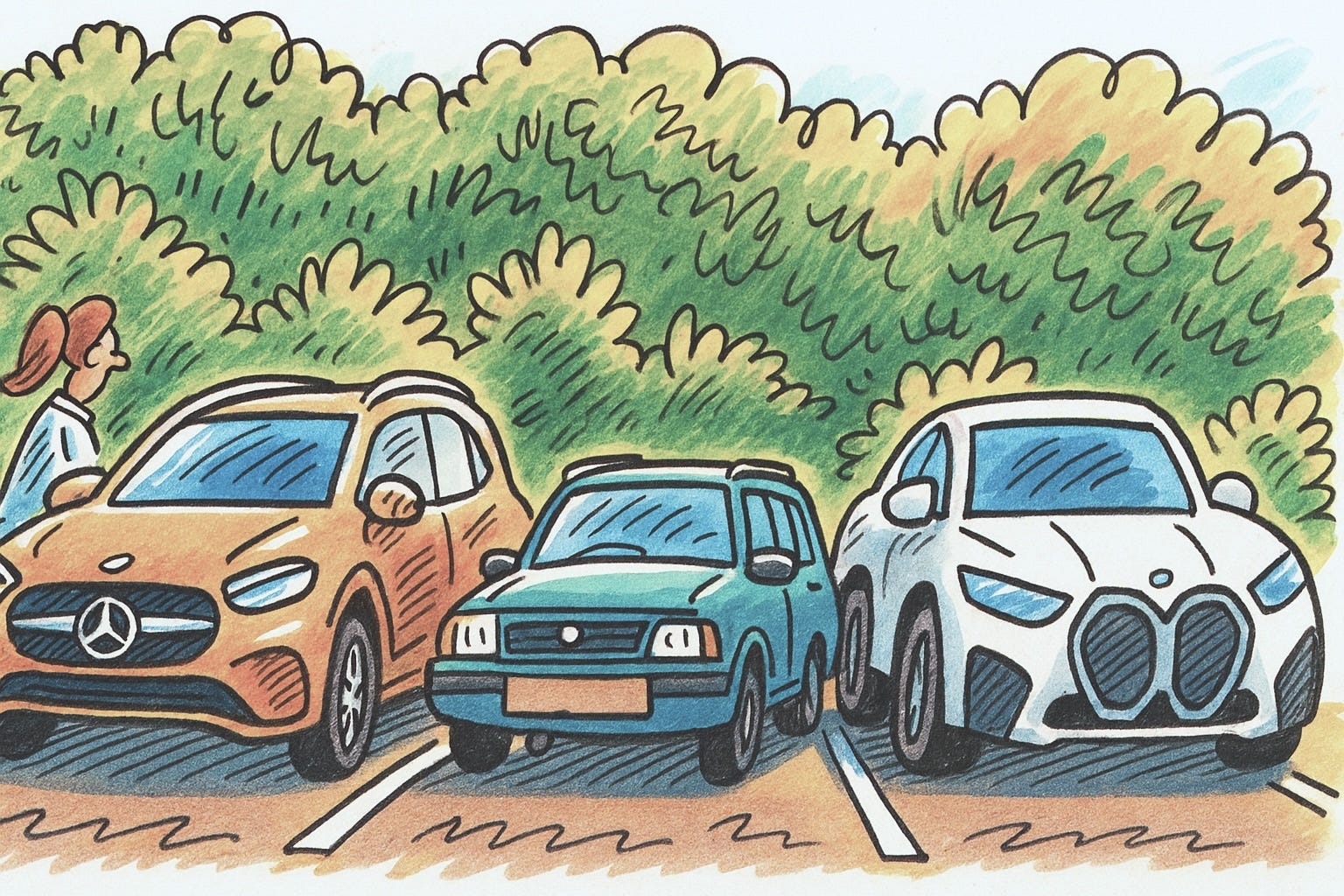
The original Hummer was a symbol of excess and masculinity in the 2000s. A civilian spin on a military vehicle, it was massive, aggressive, and wildly out of place anywhere it was sold. It looked especially absurd in cities—particularly on the small, centuries-old streets like the ones we have in London—but even seeing one sitting in a North American driveway pretty much meant that someone had chosen to think differently.
A Hummer was, by design, the largest it could be while still legally considered to be a car. But a vehicle that wide and that heavy struggled to fit the roads of the time, often becoming a nuisance in the parking lot.
Fast forward 20 years, and the 2000s Hummer H2 wouldn't even stick out anymore. Cars have grown out of proportion, and run-of-the-mill electric SUVs have now reached the size and weight of their once-absurd forerunner. Our little two-lane street in London has effectively become a one-way road, thanks to the behemoths parked on either side. Where five of the old Minis would fit, now it's just two of these large things. At least the original Hummer came in fun colors and not only gray.
These new “family-friendly,” “future-facing” “cars” pretty much cancel out a decade's worth of progress in per-vehicle fuel efficiency. And the odd thing is: Even their owners don't seem to really love them. Unlike the Hummer H2, the new SUVs don't seem to have made it on any garage posters. So who's buying them?
The Safety Arms Race
People don't judge things in isolation. Size, value, and status only matter in context. When you see a massive SUV parked on the street, you compare it to the other cars next to it. A Hummer blends in at a parking lot full of other Hummers. If all other cars are from the 70s, even a modest modern crossover starts to look like a tank. This tendency is known as “anchoring,” and it shapes everything in our lives—from how we dress to when we wake up in the morning, all the way down to how safe we feel behind the wheel.
As roads fill up with bigger vehicles, smaller ones start to feel vulnerable, even if safety data doesn't back that up. People move up the size ladder to feel safer, which only makes the small cars look smaller. It's a classic arms race, now fought with the crumple zone.
In game theory, the "best move" for each player often depends on what they expect others to do. The safety argument for larger vehicles creates what game theorists call a “classic coordination problem.” Each individual’s decision to buy a bigger car is perfectly rational, but when everyone makes the same “rational” choice, the collective outcome is worse for each individual.
If everyone else is driving tanks, the rational move indeed is to get your own. But once the majority of drivers upsize, the game will unstoppably head in a direction nobody would freely choose. A Nash equilibrium, or a situation in which no individual can improve their position by changing strategy, lands us in a world where everyone drives vehicles larger than anyone actually needs.
Big cars are making cities less safe: They obscure smaller cars, increase pedestrian fatalities, strain city infrastructure, and make streets harder to navigate. But once the larger-car flywheel is in motion, there's no clear way to reverse it. No single driver is incentivized to break the cycle, so external regulation is due: Expect road limits, weight taxes, slow speed zones, and pedestrianized streets.
Brighter Futures
Self-driving vehicles could be our best shot at ending the cycle of ever-larger cars. When you remove personal ownership, you also remove many of the psychological levers that push us toward these oversized machines. Fleet operators can make more rational decisions—optimizing for battery life, uptime, efficiency, and safety—based on real numbers rather than on mere feelings.
Even better, in a comprehensive review, transportation researchers Joschka Bischoff and Michal Maciejewski estimated that a single autonomous vehicle (AV) could replace up to eleven privately owned cars in an urban fleet. Parking demand follows suit. Separate research by university professors Wenwen Zhang and Kaidi Wang found that shared AVs in Atlanta could reduce parking demand by as much as 90%, which would free up vast amounts of city space for people to use.
Once autonomous fleets reach critical mass, car ownership in a city could start to feel as quaint as owning a horse. The shift may happen faster than anyone expects, but in the meantime, and for the love of all that is holy: Buy these massive machines if you must, but park them outside our quaint little street.